top of page
Search

Shoguns at the Garden: Did the Knicks Break the Color Barrier Five Years Earlier than the Assumed Date?

  • Writer: Avi Aronsky
    Avi Aronsky
  • Jul 17, 2025
  • 3 min read

Updated: Jul 22, 2025

A few games into the Las Vegas Summer League, the player that has perhaps most captured the hearts of Knick fans is Japan’s Yudai Baba. Owing to his elite speed, the 6'5" guard has been dubbed “Tokyo Drift.” Likewise, Japanese announcers tend to punctuate his tomahawk dunks with shouts of “Baba boom!” At twenty-nine, Yudai is the oldest member of New York’s summer roster.  Not surprisingly, he has already logged a combined seven pro-seasons in the Japanese, Australian, and the NBA G (development) leagues. Even if the slashing baller were to defy the odds and make the club, he would not be the first Knickerbocker with roots in the Land of the Rising Sun.

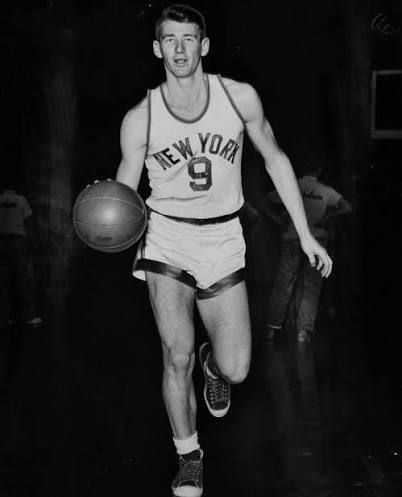
In the 1947 draft, New York selected Wataru “Wat” Misaka, a Japanese-American point guard, in the seventh round. By virtue of making the team, he essentially became the first non-white to break the color barrier of the NBA (more specifically, its forerunner – the Basketball Association of America). However, “It wasn’t a big thing” at the time, Misaka recalled. “No one cared.” For all intents and purposes, the media refrained from marking his historic debut (some of this nonchalance might have stemmed from the fact that the rival National Basketball League had already integrated Black players). While Jackie Robinson had joined the Brooklyn Dodgers earlier that year, the Association would only integrate its first black player—Earl Lloyd of the Washington Capitols—on October 31, 1950, during the season following the merger between the BAA and NBL into the National Basketball Association.  

Growing up destitute in Ogden, Utah, Misaka faced heavy persecution due to his Asian identity. Nisei (second-generation Japanese) youth were even confined to their own sports leagues. At high school, Misaka was the anchor behind a state title in basketball. Following a stellar two-year run as the point guard of a local junior college team, he enrolled at the University of Utah.

When the internment decree hit the American-Japanese community soon after Pearl Harbor, Misaka was fortunate that his distant town was outside the relocation zone. Consequently, he was able to stay put—a right denied to the nearly 120,000 interned Japanese-Americans—and continue his studies. Nevertheless, Misaka was exposed to strong anti-Japanese sentiments during the war. Even at home games, the local product was the target of ugly heckling. 

In 1944, the Utes won the NCAA title. Shortly after, Misaka enlisted in the military and helped administer the US occupation of his ancestral land, including a stint in Hiroshima. His playing career resumed in 1946-47. Besides 22 points from Arnie Ferrin, Misaka’s stingy defense keyed Utah’s triumph in that year’s NIT championship game at Madison Square Garden (until the mid-1950s, the National Invitation Tournament was even more prestigious than the NCAA). According to the Times’ account, “Little Wat Misaka . . . was a ‘cute’ fellow intercepting passes and making the night miserable for [runner-up] Kentucky.”

The New York crowd was enraptured by the guard’s hustle. As a result, Ned Irish—the Knicks’ GM, whose player-personnel calculations also took account of prospects’ box-office appeal—signed Misaka to a one-year deal. However, coach, Neil Cohalan was evidently unimpressed by the rookie. After seeing action in all of three games, the Knicks cut the Ogden product. That said, the club was generous enough to honor Misaka’s full contract.

His popularity notwithstanding, the Japanese-American encountered discrimination in the Big Apple as well: “I learned to avoid confrontation. I wouldn’t go into a nice restaurant without my teammates. I wouldn't go out much at all. It was just basketball, eat, sleep. Actually, the New York fans were probably better than the fans back home. But I still heard a few yell, ‘Jap go home.’ And they weren’t talking about Utah.”

In a sense, Wat Misaka paved the way for Baba’s warm welcome by the Knick faithful. The latter-day prospect has naturally been spared the animosity that his forerunner endured throughout his youth and early adulthood. Be that as it may, it is worth reflecting on Misaka’s trailblazing contributions to both the game of basketball and the integration of minorities into American society.

Wat Misaka (left) and Yudai Baba


1 Comment


Avi
Jul 18, 2025

It just dawned on me that my original title, "The Sun Rises at the Garden: The Knicks Venerable Japanese History," was a bit too understated. What's more, I fixed the issue of the footer blocking the comment box. 🫡

Edited
Like
bottom of page