Holcombe Rucker’s Life Work: Education via Basketball
Although Holcombe Rucker is best known for establishing and cultivating the eponymous basketball tournament, his personal biography is no less inspirational. Growing up in a poverty-stricken family headed by his grandmother, the Harlem native was mercilessly teased by classmates for lacking the right style and accoutrements. In consequence, he would regularly cut class and seek haven in the neighborhood’s parks, spending countless hours on their blacktop courts.
Rucker was a decent player for Manhattan’s Benjamin Franklin High School. However, he dropped out after his sophomore year and joined the Army. During World War II, the young enlistee served in Germany.
Upon returning home in 1946, Rucker committed himself to touching the lives of inner-city youth via education. With this objective in mind, he passed the G.E.D. exams and subsequently enrolled at City College of New York. However, the activist was compelled to postpone these studies on account of many and manifold commitments to Harlem’s kids as well as earning a livelihood for his own wife and family.
Most significantly, Rucker took a job, nay a life enterprise, supervising NYC playgrounds. According to Howie Evans, the sports editor for The New York Amsterdam News, he would seek out disadvantaged children to mentor at these locales:
Rucker spent fourteen and fifteen hours a day in his park. He was like a “pied piper.” As early as 9:30 in the morning, the kids would be waiting for him to come and start something. They never left until dusk. . . . If you hung out in Rucker’s park, you received a daily lecture on staying in school and going to college. . . . On warm days, his classroom was a park bench or basketball court. He had no books to issue, no blackboards for demonstrations, and no rewards for those who did well. What he did have came from the heart.
Under the motto “Each one, teach one,” Rucker viewed hoops as a means to prevent kids from succumbing to the temptation of gangs and crime. The unparalleled success of two all-black barnstorming clubs—the Harlem Globetrotters and New York Rens—in the 1930s and 1940s, along with the integration of black players into the NBA at the outset of the next decade, facilitated his approach, for basketball was rapidly capturing the imagination of Gotham’s youth.
During the summer of 1950, the inaugural Rucker Tournament was held at St. Nicholas Playground on 128th Street and Seventh Avenue. As befitted the founder’s emphasis on scholastics, only children with passing grades in every subject could participate. Cognizant of the fact that the long, idle months of summer constituted a pitfall for the neighborhood’s youngsters, Rucker hoped that his competition would fill part of this gaping void.
That first year the tourney’s senior division consisted of junior high school pupils. In Rucker’s estimation, younger kids were most amenable to his message. That said, the older participants were hell-bent on continuing to play in the tournament. For this reason, high school and collegiate levels were introduced the fourth year. By virtue of this expansion, Jarrod Jonsrud writes, “Rucker recognized another way he could help his” charges “acquire an education. He began contacting college scouts and coaches from all over the country to . . . watch his players perform.” Soon enough, the tournament was overflowing with university representatives. Thanks to the revised format, hundreds of New Yorkers attained college scholarships.
To further impress the scouts, Rucker unveiled the tourney’s Pro League the next summer. Within this framework, the city’s finest amateurs were pitted against a team of professional ‘cagers.’ The immense popularity of this grassroots spectacle caught the attention of myriad pro-players and playground legends. Among the renowned figures who competed in the tournament were Wilt Chamberlain, Earl Monroe, most famously Julius Erving, Connie Hawkins, Kobe Bryant, and Kevin Durant.
The Pro League games drew enormous audiences. To catch a glimpse of the action, some fans clambered up lampposts and stood atop cars. Moreover, adjacent buildings filled the role of mezzanine. To accommodate these crowds, the event sojourned through five different venues before settling into its present home on 155th Street and Eighth Avenue (near the old Polo Grounds). With this rise in prominence, the expenses to operate the tourney skyrocketed, much of which came out of Rucker’s own shallow pockets. However, the founder vehemently refused to solicit or accept corporate funds, lest the annual competition lose its educational and moral footing.
In 1961, Rucker finally found the time, albeit in the wee hours, to complete his Education degree from CCNY. Fulfilling another dream, he subsequently became an English teacher at a junior high school in Harlem.
Four years later, Rucker was diagnosed with pancreatic cancer. His wife Mary recalled that on the night before the pioneer’s demise, he was busy imploring a hospital aide to attend nursing school. In 1974, one of the parks at which he had shepherded—the P.S. 156 Playground, at 155th Street and Frederick Douglass Boulevard—was renamed in his memory.

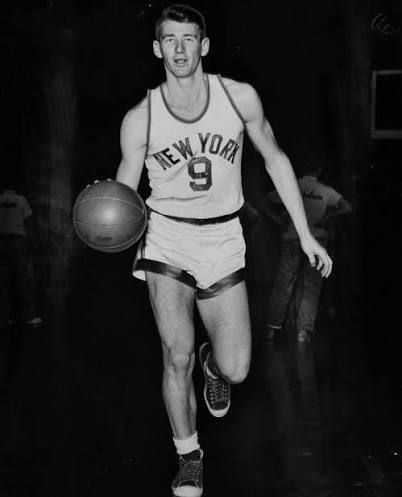


When you come to think of it, there's a close resemblance between the basketball visions of Holcombe Rucker and Dr. James Naismith. The founder's ideology was discussed in an earlier post: https://www.two-handsetshot.com/post/the-hebraic-roots-of-basketball